
Policy · Justice
Child Focused Courts: a faster road, but whose children are travelling on it?
This one is personal, so let me say why before I say anything else. Nearly six years ago, at the age of 56, I became a Special Guardian to three of my grandchildren at the end of a punishing, hyper-partisan 18-month court process I had never wanted, a process that turned family against family.
As a Black man I was blessed to have a clean and unblemished record, and I was supported by my ex-wife, a retired judge and others whose word carried weight, people who carried this ageing, shell-shocked single carer through the first four years of that kinship journey. I will be eternally grateful to every one of them. Even with that backing, I found the family court brutalising and demoralising.
So when I ask what happens to families who walk in without that backing, without that record and without anyone to vouch for them, and above all what happens to their children, it is not an abstract question. My experience took place before the reforms I describe below, but grandparents like me step in every day when parents cannot cope, and a system that does not see us will fail the vulnerable children in our care.
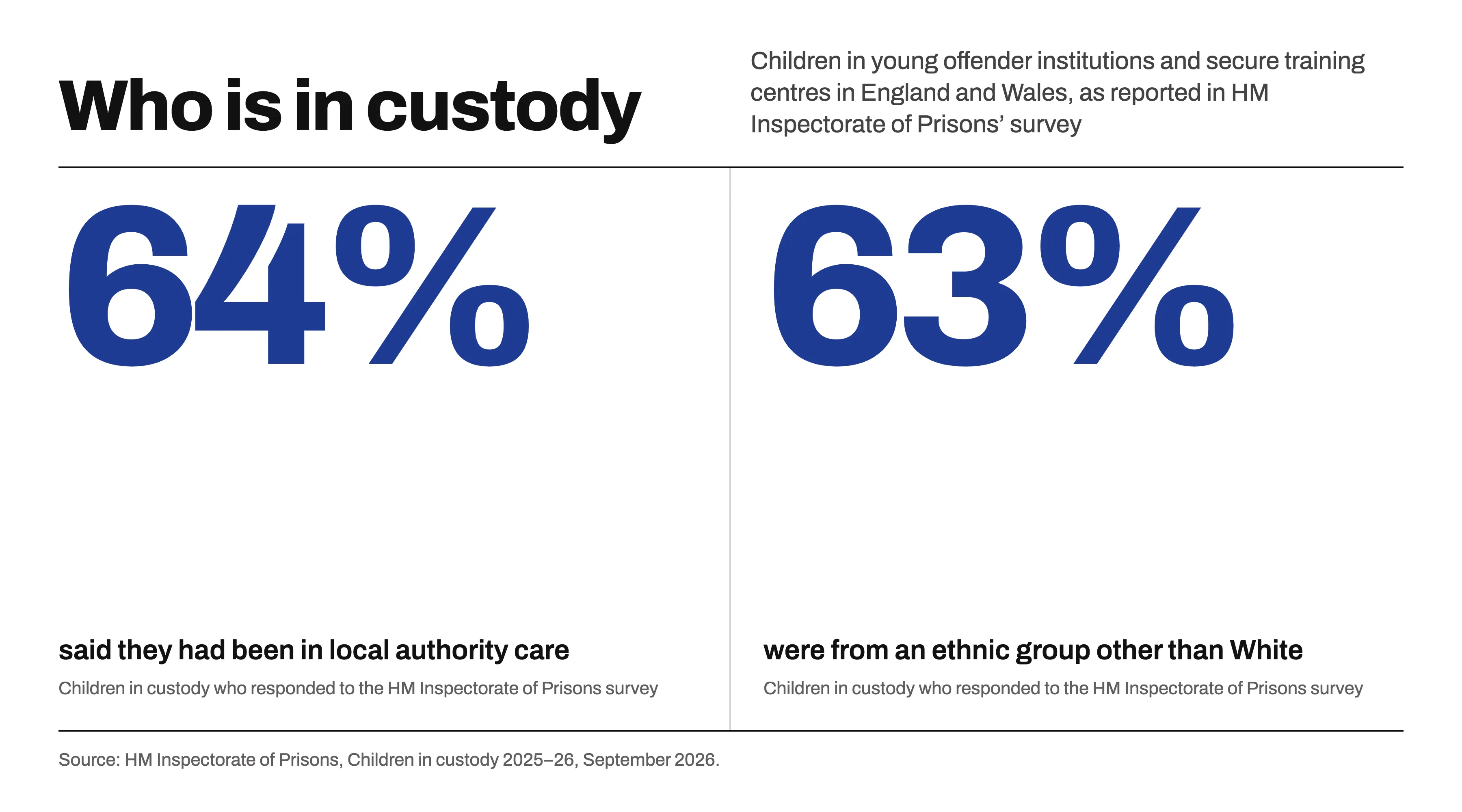
Some of you will say this has nothing to do with criminal justice. That view belongs to the old ways, before ‘systems thinking’ and the link between justice and public health became familiar, if still poorly understood, phrases. The family court is where a great many children’s paths are set. When HM Inspectorate of Prisons surveyed children in custody last year, 65% of those who responded said they had been in local authority care, and 63% were from an ethnic group other than White. That is a measure of what our systems did with those children, not of who they were. So for the children themselves, for the Black and Global Majority women who should be at the centre of how new money is spent, and for the fathers and male special guardians who are not mentioned at all, this reform deserves our closest attention.
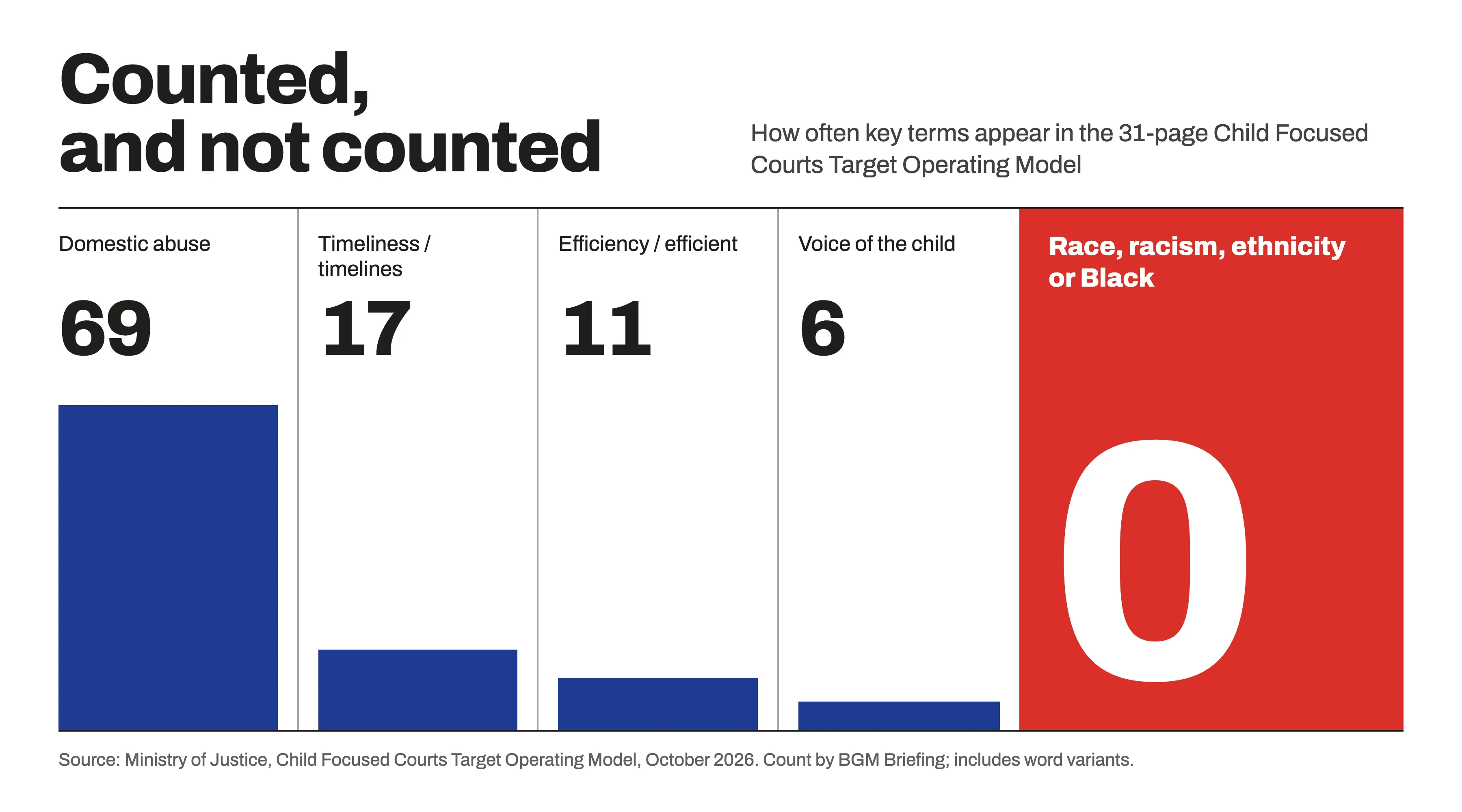
This month I took the time to read all 31 pages of the Ministry of Justice’s operating model for Child Focused Courts, and then I counted what was in it, starting with how often Black and Global Majority children are mentioned. It sets out the new way family courts decide where a child lives and who they see after their parents separate. It already runs in Birmingham, the West Midlands, West Yorkshire and the whole of Wales, £17 million has been set aside to take it to eleven more areas this year, and by March 2029 every family court in England and Wales will work this way.
The child is mentioned, in one form or another, close to three hundred times. Domestic abuse comes up 69 times. Race, racism and ethnicity are not mentioned at all. Accident or design? Neither are the words father, mother, grandparent or special guardian, and women and girls feature only inside the title of a government strategy. For a document about families, that takes some doing.
However, it is important for me to say that none of these omissions makes the reforms bad, and much here is worth defending. The old system was slow and combative, as I can testify. Survivors of domestic abuse, who feature in between 73% and 87% of these cases, too often left court feeling they had been put on trial themselves, and children were dragged through hearing after hearing, sometimes for years. The new model’s promise of one report and, wherever possible, one hearing is a genuine gift to those children. Specialist domestic abuse support is now built in and permanently paid for, and the Ministry says cases are settled up to twice as fast. That claim rests on its own court data, which others have questioned, but nobody who lived through the old waiting times will miss them.
The biggest change is that far more children will be heard. Cafcass used to engage directly with between 30% and 37% of the children whose lives were being decided, and the new model aims for between 65% and 85%. That is worth celebrating, and it raises the question the document never asks: will Black children be heard at the same rate, by people who understand them, and will their words carry the same weight?
Black children, boys and older girls especially, are too often adultified, seen as older and less vulnerable than they are. The Child Q safeguarding review in Hackney gave it a name, adultification bias, and researchers at the Nuffield Family Justice Observatory have flagged it for study in the family courts. We know this territory from the inside: BM4C and Father 2 Father have supported families living with the aftermath of exactly this kind of failure. As Dali Kaur told us last month, girls know when they are not being listened to. A child who is asked for their view but not truly heard has been consulted, not centred.
The government already knows race matters in these courts, because it paid to find out. In October 2025 it published research by the Race Equality Foundation and We Stand, based on interviews with 29 Black, Asian and minority ethnic parents (the researchers’ term; ours is Black and Global Majority). They described “a lack of cultural understanding within the court system” and said they had felt stereotyped by professionals, largely because of their ethnicity or gender. Some described harmful behaviour being waved through as a “cultural norm”, which cuts both ways: cultural ignorance can wrongly condemn a parent, and it can leave a child unprotected. The researchers called for anti-racist practice in professional training. The new model’s training section covers principles, process and trauma, and stops there. We have found no published assessment of how these reforms might affect families of different ethnicities, and would be glad to be shown one.
The single Child Impact Report draws on police checks, as it must, because a child’s safety comes first. But the Ministry’s own statistics show that Black people make up 4% of the population yet are often the most over-represented minority group in the criminal justice system, with the widest gaps at stop and search, remand and prison. A Black father or grandfather may therefore arrive at the family court carrying a record shaped partly by a system that treats him differently. Under the old model a second hearing usually gave room to explore that history. Under the new one the first report may be the whole story, and if the decision is made on paper, the family has around seven days to ask the court to think again, which is not long to have a history properly understood, particularly without a lawyer. Lawyers cost money, and legal aid is only available where there is evidence of domestic or child abuse, which puts up yet another barrier to justice. Context matters, but to be clear, no child should be put at risk so that an adult gets a fairer hearing. But a child also loses something when a safe and loving parent or grandparent is judged on his file rather than the facts. I had the record and the referees, by luck rather than design. Plenty of good men have neither.
The government did, to its credit, ask families about the pilot, but the 39 parents it interviewed came from Dorset and North Wales, and 82.1% of them were White British or White Welsh. The model now runs in Birmingham, where 51.4% of residents are Black, Asian or minority ethnic, and it is on its way to London. Evidence gathered in the Welsh hills is now being applied in Handsworth and Hackney, and nobody seems to have realised how much that matters.
The data and the money tell a similar story. Every area adopting the model receives permanent funding for domestic abuse services through its Police and Crime Commissioner, delivered “in line with the existing footprint”, which in practice means through whoever already holds the contracts. By-and-for services, which many Black and minoritised women trust far more readily, are not mentioned. Meanwhile Cafcass did not routinely record ethnicity until 2017, and the Domestic Abuse Commissioner has recommended recording the ethnicity of parents and children on every application to court. Her office now has £500,000 to study three Child Focused Court areas, reporting in 2028, with no commitment to break the findings down by ethnicity. Birmingham has run the model since May 2024. Whatever the system holds should be published now, and ethnicity, including which children are heard, should be recorded on every case from here on. Otherwise, when London goes live at the end of 2027, we will be having this conversation again over a still blank spreadsheet.
About six months before each area launches, a Local Implementation Group is formed to decide how the model works on the ground. London has roughly a year to make sure its Black and Global Majority communities, its children and young people, its mothers, fathers and grandparents, are in those rooms, rather than discovering afterwards that a document about their children managed not to mention any of them.
What you can do
-
Tell us what happened. If you have been through the family court as a parent, grandparent or kinship carer, or support families who have, tell us what the first report got right and wrong. Please leave out names or anything that could identify a child or a case. Submit your experience.
-
Ask your MP to put one question to the Ministry of Justice: “Will the Secretary of State publish an equality assessment of Child Focused Courts, release outcome data by ethnicity for Birmingham and the West Midlands, and record the ethnicity of parents and children, including which children Cafcass engages with, on every application?” Find your MP.
-
If you work with children or families in East, West or Central London, support the BGM Briefing’s call for Black and Global Majority seats, including one for young people, on the London Local Implementation Groups. Register your interest.
BM4C will request the Birmingham data under the Freedom of Information Act and publish whatever comes back.
If you need advice now: Coram’s Child Law Advice, 0300 330 5480 (Monday to Friday, 10am to 4pm). Family Rights Group advises parents and kinship carers. If a child is at immediate risk, call 999.